
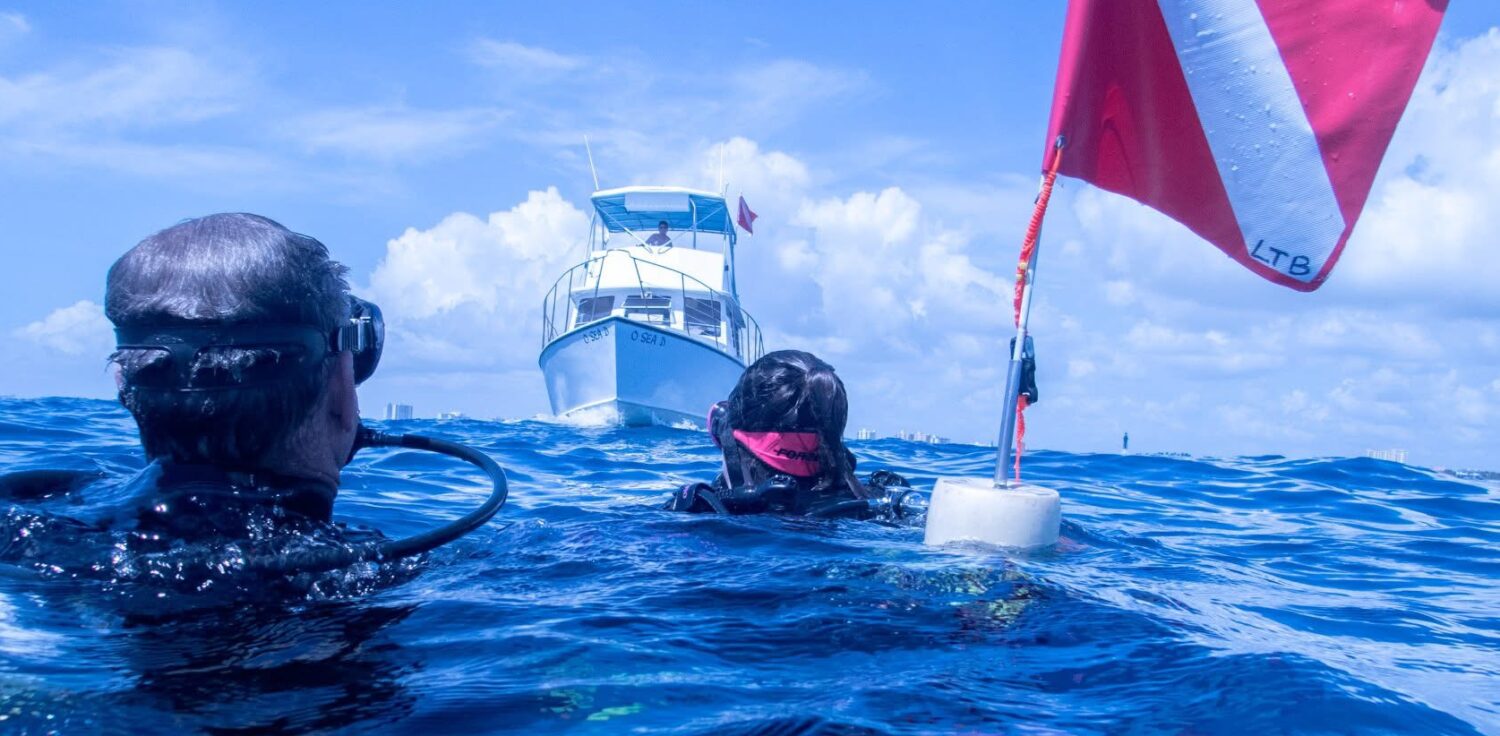
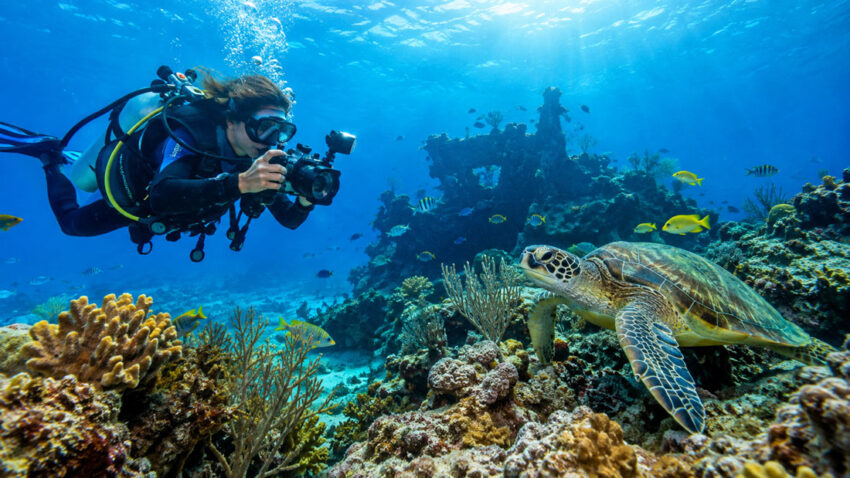
Scuba diving Florida offers photographers a remarkable variety of subjects and conditions. From shallow reef environments to deeper wrecks, every dive can present a different photographic opportunity. The challenge is that taking a great photograph underwater requires more than simply pointing a camera at a subject and pressing the shutter. Water affects light, color, visibility, movement, and distance, while currents and marine life require divers to remain calm and respectful.
Few experiences compare with descending beneath Florida’s warm coastal waters and watching the underwater world come alive around you. Colorful fish move through reef structures, rays glide across the seafloor, and sunlight filters through the water in constantly changing patterns. For many divers, these moments are worth remembering long after the dive is over. That is where underwater photography becomes special.
However, taking photographs underwater is very different from taking pictures on land. Water changes the way light travels, colors disappear with depth, subjects are constantly moving, and even a small amount of current can make it difficult to hold a camera steady. A diver also has to maintain awareness of depth, air supply, surroundings, buddy position, and marine life while attempting to capture an interesting image.
The good news is that you do not need the most expensive camera to take meaningful underwater photographs. Good preparation, patience, buoyancy control, and an understanding of light can make a bigger difference than expensive equipment.
Whether you are carrying an action camera, a smartphone in a waterproof housing, or a professional camera system, these six practical tips can help you improve your underwater photography while enjoying your next Florida diving adventure.
Scuba Diving Florida : 6 Underwater Photography Tips
1. Learn How Light Changes Underwater
Light behaves differently underwater, and understanding this is one of the foundations of good underwater photography. As sunlight travels through water, different colors are absorbed at different depths. Reds and oranges generally disappear first, followed by other colors as depth increases. Eventually, photographs can take on a predominantly blue or green appearance.
This can be surprising when you look at your photographs after a dive. A reef that looked colorful to your eyes underwater may appear much less vibrant in an unedited photograph.
When Scuba diving Florida, pay attention to the direction and quality of natural light. On a sunny day with good visibility, positioning yourself so that sunlight comes from behind you can help illuminate the subject. This can create brighter images and reduce some of the problems caused by shooting directly toward the sun.
If your camera allows manual settings, experiment with shutter speed, aperture, and ISO as you become more comfortable. Beginners do not need to change everything at once. Start by understanding one setting at a time and observe how it affects your photographs.
Artificial lighting can also restore colors that disappear with depth. An underwater strobe or video light can make coral, fish, and other subjects look dramatically more natural. However, artificial light needs to be used carefully. Positioning the light too close to the camera’s center line can illuminate suspended particles and produce unwanted back scatter.
A good starting principle is simple: understand the available natural light first, then use artificial light to enhance the subject rather than simply making the entire scene brighter.
2. Get Close, But Give Marine Life Space
One of the most useful rules in underwater photography is to get closer to your subject. This may sound obvious, but it is particularly important underwater because water between your camera and the subject can reduce sharpness, contrast, and color.
If you photograph a fish from several meters away, there may be a significant amount of water and suspended particles between the lens and the animal. Moving closer can make the subject larger in the frame and produce a cleaner image.
But there is an important difference between getting close and chasing wildlife.
Marine life diving Florida experiences should always be approached with respect. Fish, rays, turtles, and other animals should never be chased, touched, cornered, or manipulated for a photograph. A photograph is not worth causing stress to an animal or damaging its habitat.
Instead, slow down and observe.
If you see an interesting fish, stop swimming toward it aggressively. Maintain good buoyancy and allow the animal to become accustomed to your presence. You may find that a calm diver can get much closer than a diver who constantly swims after the subject.
Patience can also produce better photographs. Watch the animal’s behavior and anticipate where it might move next. Position yourself in a place where the animal is likely to enter your frame rather than following it around the reef.
This approach is particularly useful during Scuba diving trips Florida, where you may have opportunities to encounter a wide variety of marine species. Sometimes the best photograph is the one you get after waiting quietly for the right moment.
3. Make Buoyancy Your Photography Superpower
Good buoyancy is valuable for every diver, but it becomes especially important when using a camera underwater.
When you are trying to photograph a small fish or detailed section of coral, even minor body movement can cause the image to become blurry. If you are constantly adjusting your position, kicking your fins, or struggling to remain stationary, composing a photograph becomes much harder.
Good buoyancy allows you to hover comfortably while keeping your camera steady.
It also helps protect the environment. A diver who has poor buoyancy may accidentally kick the bottom, stir sediment, touch coral, or bump into marine life. Apart from being harmful to the environment, this can ruin your photograph by creating a cloud of particles.
Before taking a photograph, establish a stable position. Keep your movements slow and controlled. If the conditions involve current or surge, recognize that you may need to compensate for movement rather than trying to remain completely motionless.
Remember that photography should never interfere with basic dive safety. Continue monitoring your depth, air supply, buddy, surroundings, and dive plan. It is easy to become absorbed in photographing a fascinating subject, but the camera should never become a distraction from responsible diving.
For photographers who are still developing their skills, spending an entire dive simply practicing stable hovering can be extremely valuable. You may return with fewer photographs, but the images you capture are likely to be much stronger.
4. Think About Composition Before Pressing the Shutter
A technically sharp photograph can still be uninteresting if the composition does not guide the viewer toward the subject.
Underwater environments provide many natural tools for creating strong compositions. Reef formations, wreck structures, coral branches, schools of fish, sunlight beams, and open blue water can all become part of the photograph.
Instead of automatically placing your subject in the middle of the frame, experiment with different positions. Leave some open space in front of a swimming fish so the animal appears to have somewhere to go. Position a diver beside a wreck to demonstrate the size of the structure. Use coral or another foreground object to frame a marine animal.
Think about what you want the viewer to notice first.
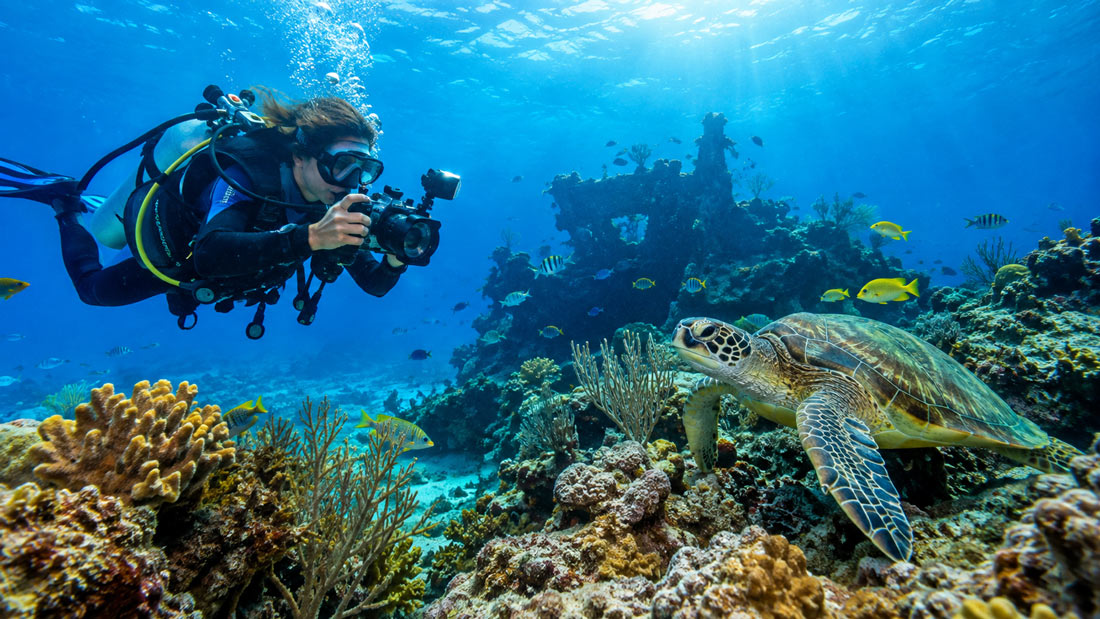
For example, imagine photographing a turtle above a reef. If the turtle occupies only a tiny portion of the photograph while the background contains a lot of empty water, the image may lose some of its impact. Moving closer or changing your composition can make the turtle the clear focal point.
The same principle applies to wreck photography. Rather than photographing a large wreck without context, look for interesting openings, textures, marine growth, or a diver moving through the scene.
During Scuba diving Florida, you may encounter familiar subjects repeatedly. Composition gives you a way to photograph those subjects differently.
Do not be afraid to take a few seconds to adjust your position before pressing the shutter. Sometimes moving just a little to the left, right, higher, or lower can completely change the photograph.
5. Choose Equipment You Can Confidently Use
Underwater photography equipment ranges from simple action cameras to sophisticated professional camera systems. The best choice depends on your experience, budget, and photographic goals.
An action camera can be an excellent starting point. It is compact, relatively easy to operate, and capable of capturing both photographs and video. Smartphone housings can also be useful for casual underwater photography when properly designed and tested.
More advanced photographers may use mirror-less or DSLR cameras with dedicated underwater housings, interchangeable lenses, strobes, and other accessories. These systems provide much greater control, but they also require more preparation and practice.
The important point is that expensive equipment does not automatically produce better photographs.
A diver who understands composition, buoyancy, lighting, and marine behavior can create excellent images with relatively simple equipment. Meanwhile, someone using a sophisticated camera may struggle if they do not understand how to use it underwater.
Before every dive, inspect your housing carefully. Check seals and O-rings for dirt, hair, sand, or other debris. Confirm that batteries are charged and memory cards have sufficient space. Test the controls before entering the water.
If you are using rented equipment, make sure you understand how it works before the dive begins. It is much better to learn camera controls on the surface than while trying to photograph a fast-moving fish at depth.
During Scuba diving trips Florida, preparation is particularly important because you may have limited opportunities to repeat a specific dive. A few minutes spent checking your equipment can prevent disappointment later.
6. Be Patient and Photograph Responsibly
The most valuable photography skill may be the one that has nothing to do with the camera: patience.
Underwater environments are constantly changing. A school of fish may suddenly move across the reef. A ray may appear from the distance. A turtle may swim into the perfect position. Sunlight can shift as clouds move across the surface.
You cannot control these moments.
Instead, learn to observe and wait.
If you see a promising subject, slow down and watch what happens. Rather than chasing an animal, find a comfortable position and allow the scene to develop. This can result in photographs that look much more natural.
Patience is also closely connected to responsible marine photography.
Never move coral to improve a composition. Do not pick up animals, touch wildlife, or disturb the seafloor simply to create a better image. Avoid damaging fragile habitats with fins, cameras, tanks, or other equipment.
Responsible photography ensures that the underwater environment remains healthy for future divers and photographers.
This is especially important during Marine life diving Florida, where encounters with wildlife can be among the most memorable parts of a dive. The goal should be to observe these animals as they naturally behave, not to control the encounter.
A photograph should document the underwater world, not interfere with it.
Understanding Different Photography Opportunities in Florida
One of the great advantages of Florida is the variety of underwater photography opportunities available to divers.
Reef environments can provide colorful subjects and wide-angle scenes. Wrecks can create dramatic structures and interesting backgrounds. Sandy areas can reveal smaller animals that might otherwise be overlooked. Schools of fish can create dynamic compositions, while rays and turtles can provide opportunities for larger wildlife portraits.
Different environments may require different photography approaches.
For example, wide-angle photography can work beautifully when you want to capture a large reef or wreck with a diver included for scale. Macro photography can be better when you want to highlight a small creature or detailed section of marine life.
Learning to recognize these opportunities can improve your photography without requiring new equipment.
Before the dive, think about what you might encounter and how you would like to photograph it. At the same time, remain flexible because underwater conditions and marine behavior are impossible to predict completely.
How to Improve Your Photography After Every Dive
Improvement does not stop when you leave the water.
Spend some time reviewing your photographs after each dive. Look at the images that worked and those that did not. Ask yourself a few simple questions.
Was the subject close enough? Was the image sharp? Did the photograph have distracting elements? Was there enough light? Was the subject positioned effectively within the frame? Did your buoyancy affect the composition?
Do not become discouraged by unsuccessful photographs. They are part of learning.
If an entire collection of photographs has a blue cast, you may need to learn more about white balance or underwater lighting. When images are blurry, consider improving camera stability. If your subjects appear too small, practice getting closer while maintaining respectful distances.
You can improve quickly when you turn each dive into a learning experience.
Making Photography Part of the Diving Experience
It is important to remember that an underwater photography dive is still a dive.
Do not spend the entire experience looking through your camera screen. Take time to look around you. Watch how fish move through the reef. Notice the sunlight above. Listen to the rhythm of your breathing and appreciate the feeling of being weightless underwater.
Sometimes the most memorable moment will not be the photograph you take.
Perhaps a ray will glide silently overhead. Maybe a large school of fish will surround you. You may notice a tiny creature hiding among coral that you would normally overlook.
These experiences are part of what makes Scuba diving Florida so rewarding.
Photography simply gives you another way to remember them.
Final Thoughts
Underwater photography combines diving skills, creativity, patience, and an appreciation for the marine environment. You do not need to become a professional photographer to capture meaningful images. Start with the fundamentals: understand underwater light, get close without disturbing marine life, develop excellent buoyancy, improve your composition, use equipment you understand, and learn to wait for the right moment.
Florida provides an extraordinary setting for practicing these skills. From colorful reefs and fascinating wrecks to unexpected wildlife encounters, Marine life diving Florida can give photographers something new to discover on almost every dive.
Whether you are planning local dives or joining Scuba diving trips Florida from another part of the country, approach each dive with curiosity rather than pressure to capture a perfect photograph. The best images often happen when you slow down, observe your surroundings, and allow the underwater environment to tell its own story.
Ultimately, great underwater photography is not just about producing a technically perfect image. It is about capturing a moment that communicates what it felt like to be there. When your camera becomes a tool for observing rather than a reason to chase, photography becomes a natural and rewarding part of the diving experience.